
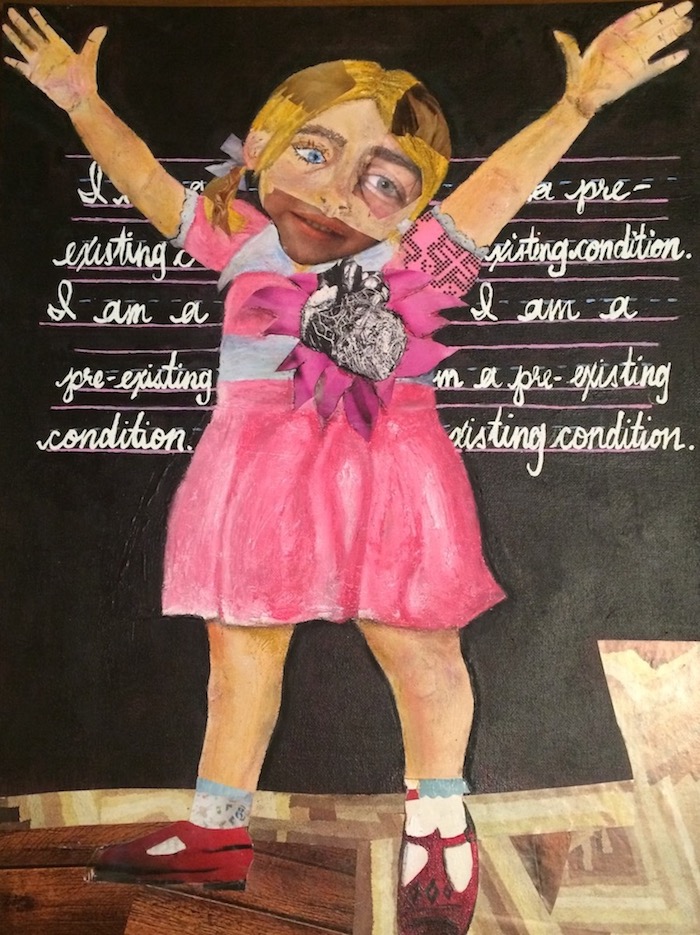
the feminine mistake.
Mixed Media on Canvas Board
61cm x 46cm
2017
In the United States’ poor excuse for a health care system, a ‘pre-existing condition‘ is a medical condition that began before a person’s health coverage went into effect. Before the Affordable Care Act (ACA), colloquially known as Obamacare, was passed into law in 2014, insurance companies were often legally allowed to deny coverage to those with a pre- existing condition – that is to say, those who most needed health insurance in order to afford treatment and prescriptions. As the conservative branch of our government regularly works to break down the tenets of the ACA, the fate of those who most need treatment remains to be seen.
Amongst those most in need of affordable, reliable, and accessible healthcare are women. The list of women’s reproductive health concerns, as published by the Center for Disease Control (CDC), is lengthy, but many are preventable, treatable, or curable, when healthcare is provided. Clinics, such as the contentious Planned Parenthood, have been able to offer no- and low-cost treatment, care, and counselling to patients. However, as they also provide family planning services and abortion, they are under attack by (mostly) white, cis, male conservative lawmakers who are working diligently to retract its federal funding and close facilities. In 2019, nearly 50 years after President Nixon signed Title X into law, guaranteeing affordable birth control and reproductive health care to women with low income and stating that ‘no American woman should be denied access to family planning assistance because of her economic condition,’ we are still fighting to retain these rights. Forty-seven years after the landmark Roe v. Wade decision to nationally legalize abortion, that right is in danger of being reneged. In 26 states – to put this in perspective, more than half of the US – women who choose abortion are currently required to undergo ultrasounds and, in 3, are obligated, rather horrifically, to listen to the foetal heartbeat while looking at the image on screen.
As our right to sane, affordable, and comprehensive healthcare, or lack thereof, seems to be the zeitgeist of all times in the US, feminist artists have long dealt with the subject. Most notably for me, the artist collective Sister Serpents comes to mind, having been birthed as a direct response to the 1989 United States Supreme Court decision allowing for states to withhold public funds to run facilities and hire employees to perform, assist with, or counsel women on abortions. But, as the 1980s now seem ancient history, it’s shocking that art on this subject is anything more than a dated remembrance of the dark ages. Instead, it’s revitalized in all forms. Margaret Atwood has released The Testaments, the sequel to her dystopian and frighteningly possible story, The Handmaid’s Tale this year because, as she put it, ‘for a while we thought we were moving away from [the book]. And then we turned around and started going back toward it’.
Since the Trump administration took office, I think women have felt the need to band together in protest for protection and support. I have come across many feminist communal arts projects and collectives doing just that. The Exquisite Uterus Project is a notable and ongoing example. The art piece is meant to ‘articulate [the] outrage at recent increased restrictions to women’s full access to good sexual and reproductive health care and growing limitations on our ability to determine our own reproductive choices’. Participants in the project are ‘urged to have fun with it but to consider how our ability to take control of our own personal uterus (and health care decisions) is a very serious and, now, political issue.’
While I find Fourth Wave Feminist activism, community, and art exciting, and contextualize much of my own art practice within it, I wish I didn’t find it necessary. As Catherine Morris, curator at the Sackler Center for Feminist Art at the Brooklyn Museum said about an exhibition called A Year of Yes: Reimagining Feminism held shortly after the first – and most hopefully only – Trump election, ‘[w]e might have been thinking more about a celebration, and now we have a sense of urgency’. Sadly, and ironically, as this cause is already tired and storied, there is a sense of urgency to do something, to make art, to be heard and listened to. But haven’t we already tried this? Frankly, I’m tired of waging the same war so many generations before me have already fought. Why must I earn the freedom of choice and rights to the body I inhabit when the male gender is granted these rights at birth? Why do those, who are already imbued with rights to their own bodies, want rights to mine, as well?
As a woman, I am a pre-existing condition. Only I am not covered under the caveat in the ACA currently protecting those in need. And so, the fight continues.
Words: giacinta frisillo www.giacintafrisillo.com









 decoratingdissidence.com