

cw: intimate partner violence
Smog
Did you see it?
How I slowly disintegrated,
And crawled further
And further
Within myself?
How my voice was no longer my own
And all that slipped out of my lips
Were the pretty lies of
the golden bars twisting around my golden cage,
Suffocating me with glittering, iridescent smog.
Poem from the back of the painting, Smog, 2021
A grandmother saves pennies out of her weekly allowance for food and household items to buy her four granddaughters each a gold bangle. A mother buys anklets and earrings to give to her daughter.
Why?
Not for beauty, and not for wealth. But for protection and chance for freedom – the most valuable jewels they can gift the women that they love.
In a 2022 Brown History article “The quiet feminism of South Asian women,” journalist Rosa Kumar references that allegedly South Asian women hold 11% of the world’s gold. In a tradition that spans generations, mothers and grandmothers hand gold and jewels to their daughters and granddaughters as protection from ‘bad marriages’ – an escape fund on their wrists, ankles, and noses.
When we think of the words glitter or jewels, it’s easy to think of either the physical, plastic-based sparky flecks that humanity collectively enjoys plastering on objects and ourselves, or the metals and gems we adorn our ears, fingers, clothes with. This is merely the physical manifestation. A jewel is a gift, and the glitter is the sparkle – the value. The real glitter – the real gold – is what these jewels represent, and for these women, they hold power:
Protection. Safety. Freedom.
We spend our time gathering this in visible glitter. We search for love, for companionship, for understanding – our lives are a collection of beautiful gems stitched together and draped over our shoulders.
However, “all that glitters is not gold”.
Intimate partner violence (IPV), or as many cultures like to refer to it ‘bad marriages or relationships’, tend to begin in the same way: with a tactic called ‘love bombing’. Throughout an intense period of romantic gestures, the victim is often spun into a web of feeling loved and adored. The new partner gifts declarations of love and friendship. The perpetrator will behave in a way that leads a victim into believing that they are understood and are being heard – maybe for the first time in their lives. The beautiful gems that we humans search for – friendship, love and safety – are twisted and used to lull a person into a false sense of security. The bangles adorning their wrists are shackles made of muck coated in fake iridescence.
As the relationship progresses, a cycle becomes apparent. Periods of love bombing follow periods of emotional or physical violence – when it’s good it’s really good, but when it’s bad its really bad. And the cycle repeats. The purpose of this process is to trap someone into believing that the person that they are with loves them and, if they just tried harder, they would be treated better (the same way they were treated at the beginning of the relationship). In doing so, an abuser guarantees that their victim will serve them in any possible way – acts born out of fear and desire for that once loving partner.
With 1/3 of people identifying as women between the ages of 15-49 reporting that they have been subjected to physical violence by a partner, IPV is a major public health issue. This figure does not include transgender or non-binary people, however, we know that between 2020/2021 and 2021/2022, domestic abuse and sexual violence against trans and non-binary people increased by 18%. These figures only count those people who have reported IPV, so the actual number is thought to be significantly higher; a grotesque endemic of violence against huge swathes of the human population.
A large part of my work lies in articulating domestic violence, particularly the dichotomy of beauty and pain that so often surrounds IPV and abuse. The beautiful gems of love and friendship, are broken shards of costume jewellery – dangerous, and a lie. They are used to lure people into a false sense of safety – a false sense of love – and to keep victims in stasis: stuck between the moments of beauty, and the moments of pain. These promises and the accompanying fear are so convincing that it takes on average seven times to try and leave an abusive relationship. In my work, this jarring split between the pain and promises looks like blood splatters against beautiful bouquets, or sparkly gold bars over a skeletal, hollowed out figure.
In Smog, I wanted to show how throughout these relentless cycles a person’s identity can be erased, until all that is left are those words, and those fake jewels that an abuser has force-fed you. As time goes by, it is not uncommon for survivors to lose themselves, until they feel unrecognisable when they look in the mirror.
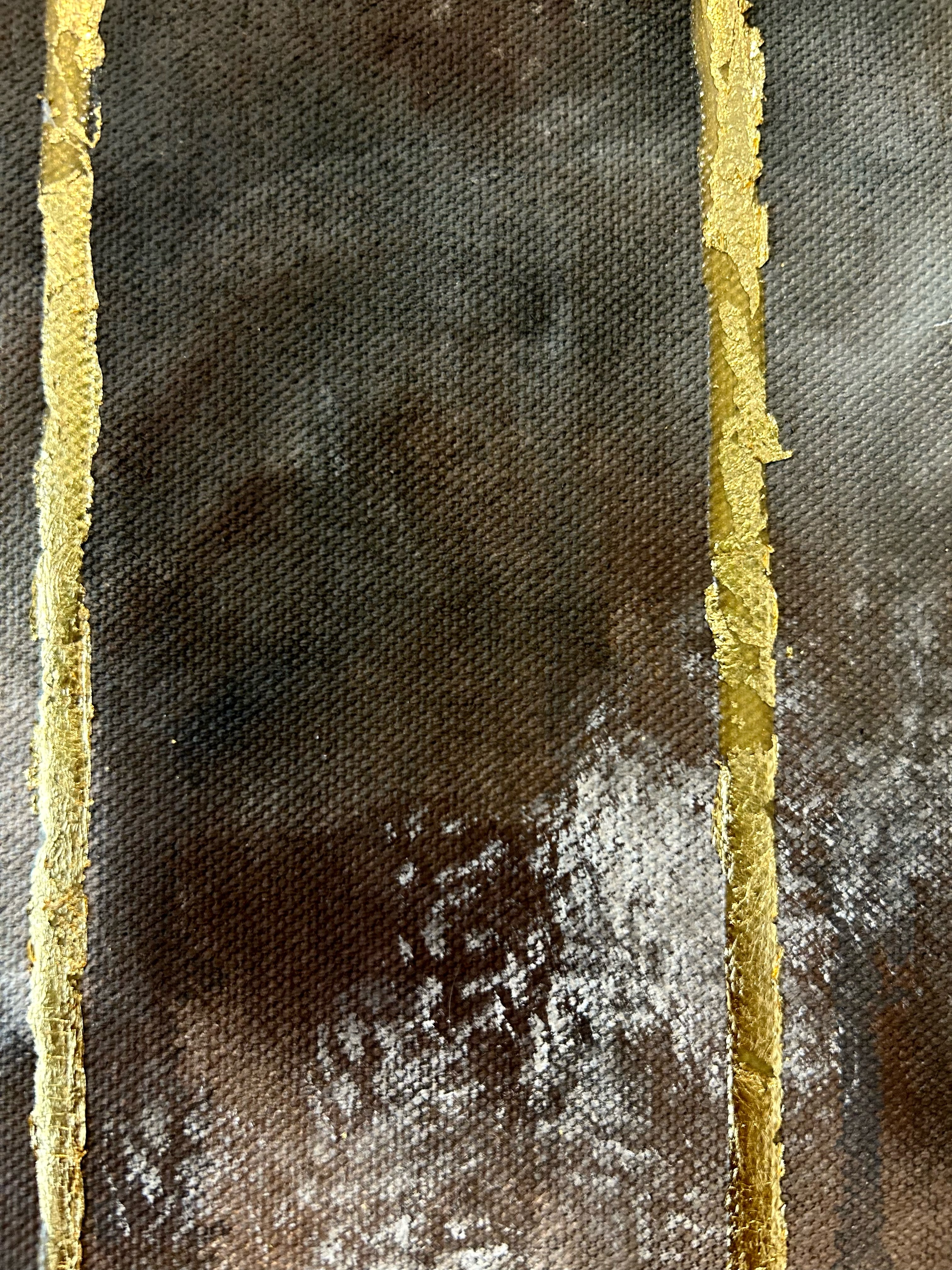
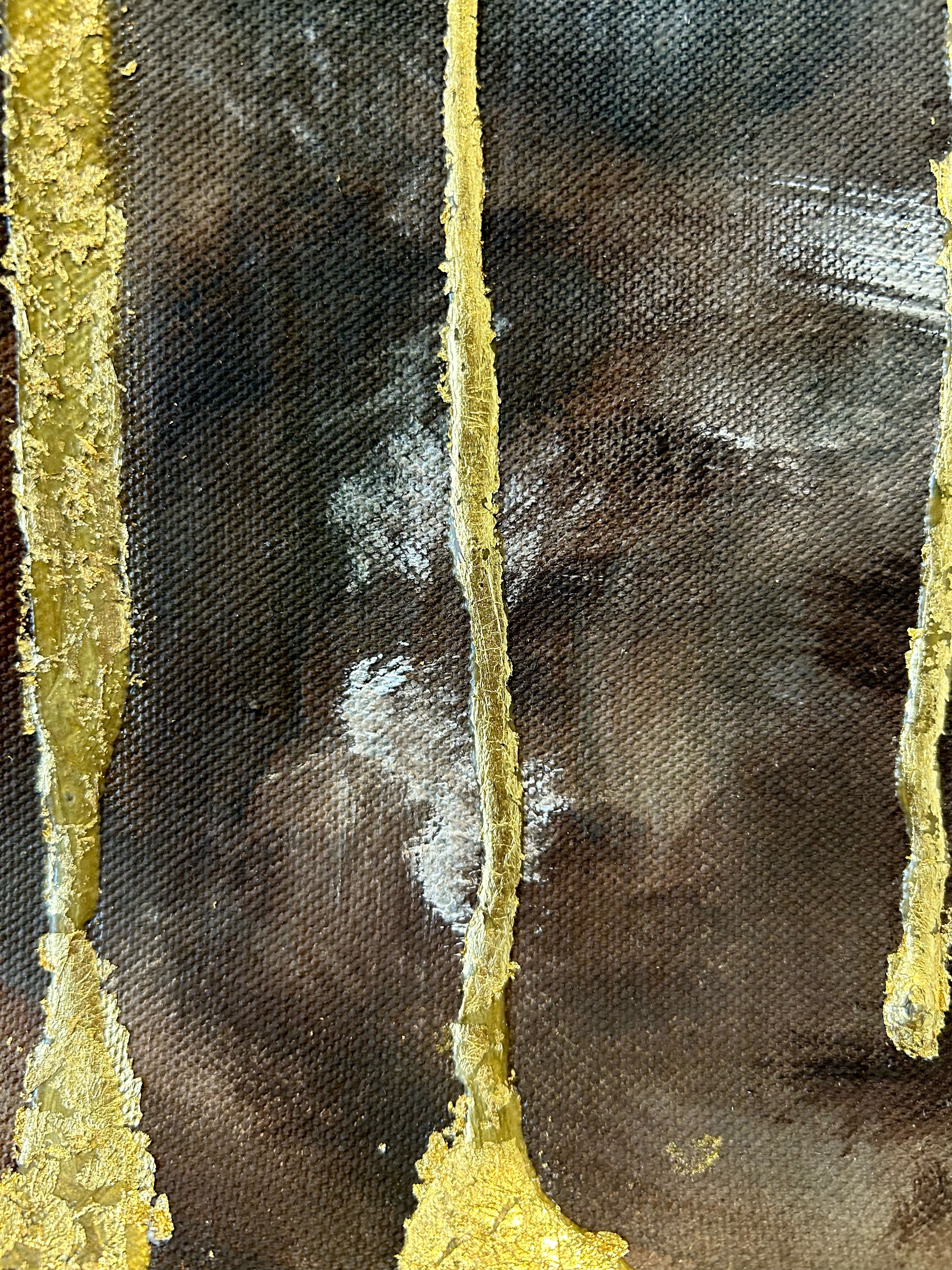
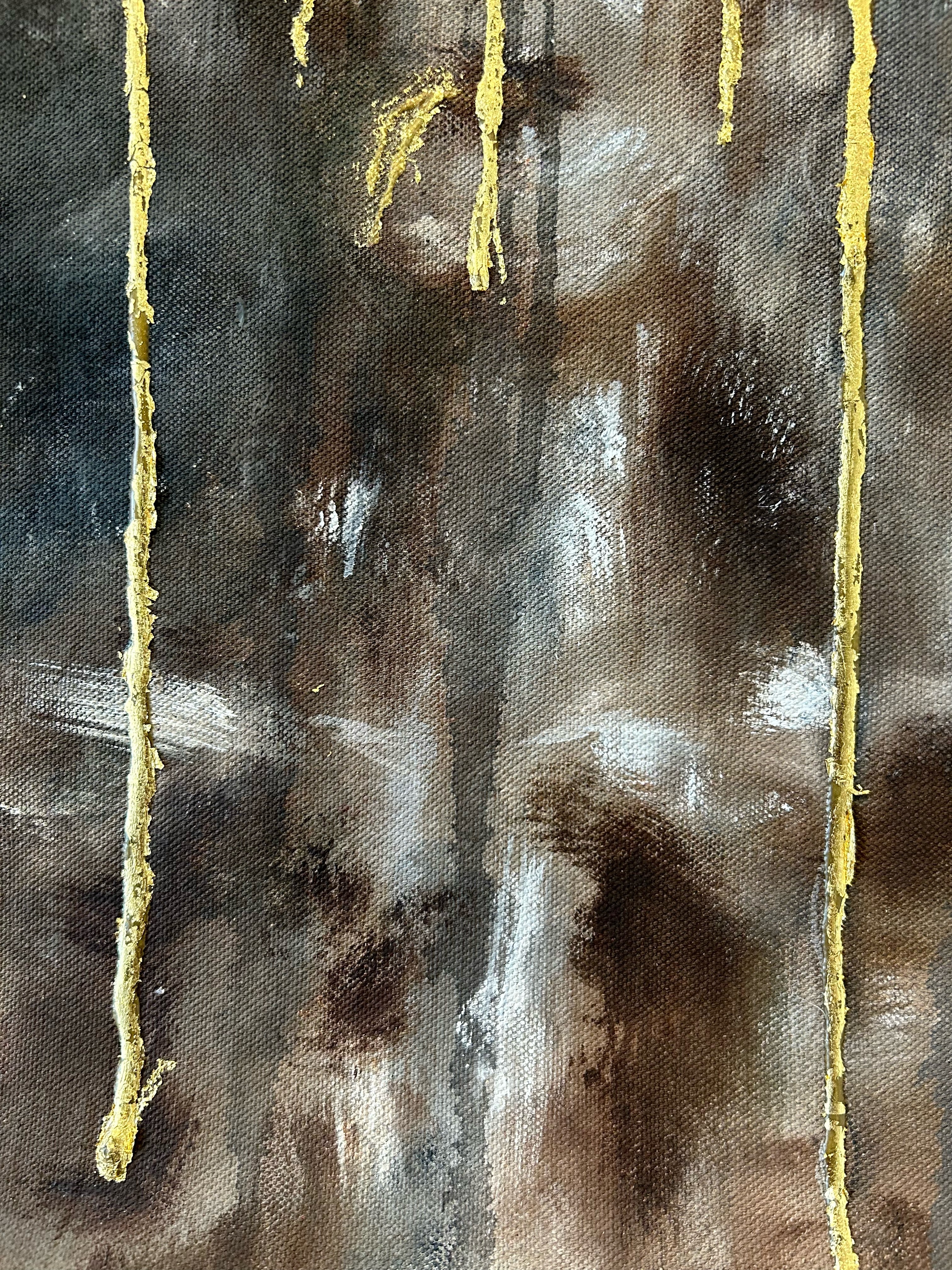
Our victim in Smog is a shade. She has been painted in a haphazard way – she is unformed and skeletal; her body barely exists. We are drawn into her hollowed out eyes, her mummified face, barely contrasted against the shadows that threaten to absorb her. Trickled over her are bright, sparkly bars, dripping across her face and slowly making their way to the bottom of the canvas. The bars are a dull gold acrylic drip, coated in imitation gold leaf, plastered on and peeling. Our shade is weeping fake gold, and it is smeared on her face with the look of it spilling out of her mouth. The most vibrant and instantly noticeable part of the piece is the glitter.
On the back of the canvas is a poem. The poem is the reality. It is hidden away and tells us what she is facing, and what she feels. I wanted to illustrate how poisoned words can seem like that same gold and glitter gifted by South Asian women to their daughters and granddaughters. How those words, wrapped in a shiny veneer are a trap – a cage. The person is an afterthought. The person is invisible. And the lies are plastered on, and peeling – layers and layers of sparkly lies.
Bio: Aziza Mirza is an abstract artist based in London, UK. Her entry into painting began before she was able to write, and since that young age she has used painting as a form of explanation; a method to express feelings, thoughts and emotions, that her words often fail to describe. Aziza has a BSc in Human Genetics and works in clinical research. Aziza is a self taught artist. Growing up in the diaspora and therefore having the privilege to be part of multiple communities, as well as through her daily work in research, and through walking through the world as a brown woman, Aziza has a unique understanding of both the fragility and power of humanity. These ideas are often included in her artwork through different, sometimes less obvious themes: domestic violence and racism, alongside the beauty of nature and raw emotion. Aziza works with acrylic and oil paint predominantly, and more recently has started experimenting with plaster in her paintings, to create more textured pieces.
For more information about Aziza and her work: www.azizamirzaart.com, and @azizamirzaart on Instagram.
For more information and support on the topic of intimate partner violence and domestic violence please visit these pages at: Refuge, NHS, Amnesty International, or the The Hotline.
 decoratingdissidence.com
One thought on “Poem: Smog”
Comments are closed.