

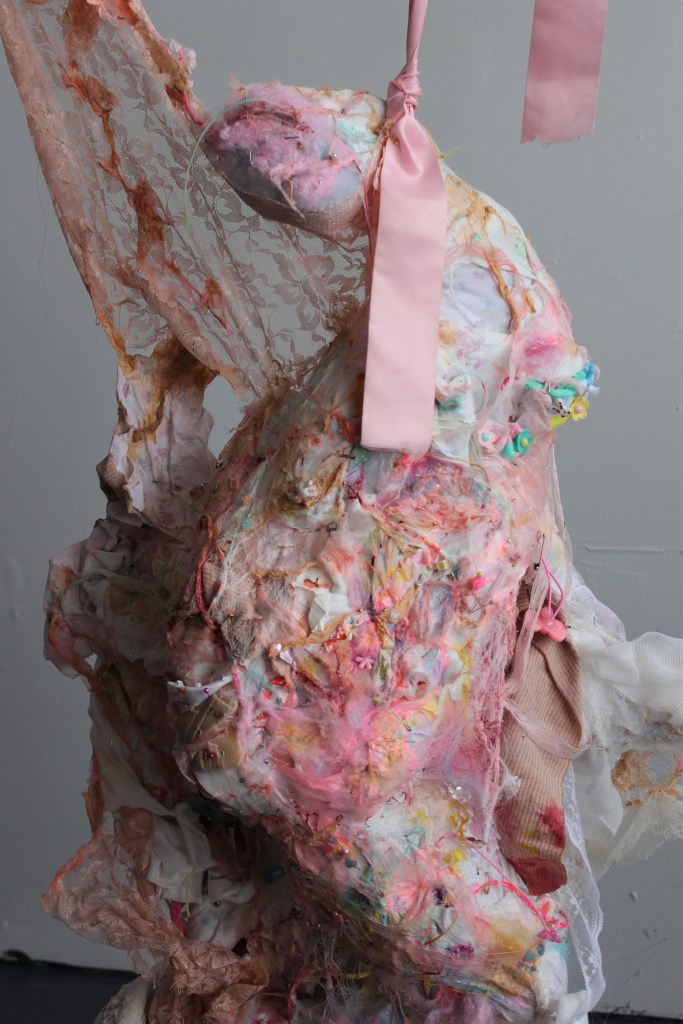
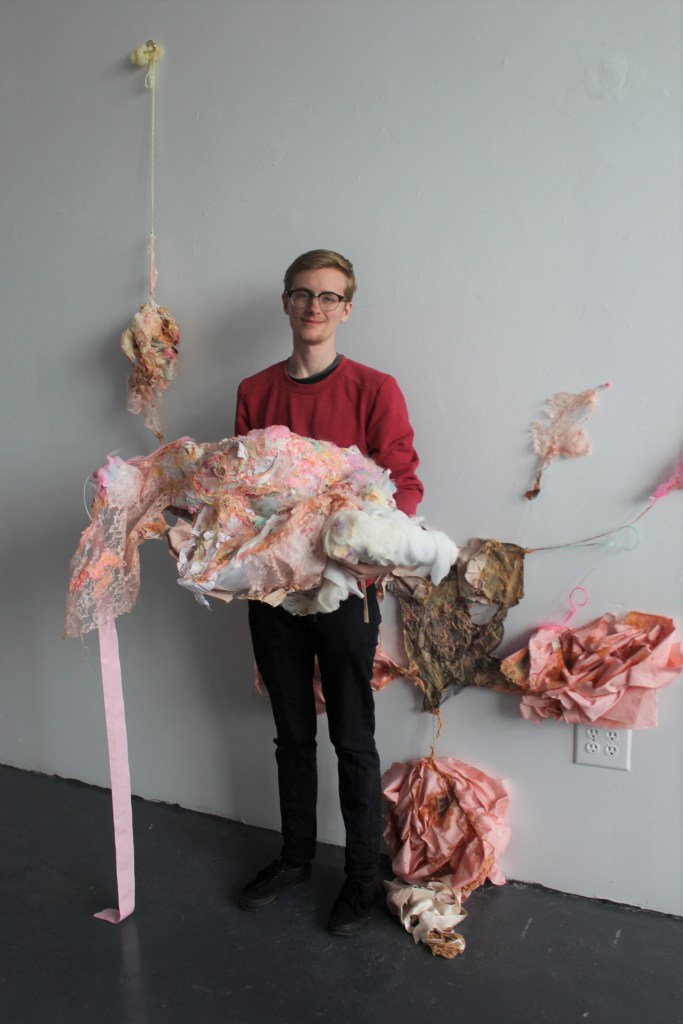
Theo Trotter utilizes textile materials and processes in conjunction with glitter glue, latex, childhood adornments, and medical supplies to create ambiguous corporeal forms surfaced with thick layers of afflicted skin. These objects retain an intimate tenderness despite their abject woundedness and convey the tensions between concepts of injury and healing. Soft sculptures subvert their inherent formlessness by means of constriction and containment which may seem forceful and damaging but is also the very mechanism preserving the objects’ existence. Lauren Bradshaw finds out more in conversation…
LB: Your most recent body of work includes sculptures that involve hanging or suspension rather than being placed on a pedestal or pinned to the wall such as in your previous works. Can you talk about the role this suspension plays in relationship to tension and/or gravity?
TT: Gravity, similar to the pins used to hold these works together, is an ambiguous force that both oppresses the body and gives it form. I also like how exposed a hanging sculpture is. When one of these objects is hung from the ceiling, every angle is exposed to the viewer, unlike a work that lives on a wall or pedestal. I also appreciate the sense of “unfixedness” in a dangling object.
LB: These works include objects and materials that retain a sense of vulnerability due to their smallness, softness, and fragility. Can you explain the reasons for choosing materials with these qualities?
TT: I find that small delicate objects have a unique strength which stems from their vulnerability. I also find it very important to maintain a sense of tenderness in my process, alongside the more “violent” aspects of tearing apart and dismantling the materials.
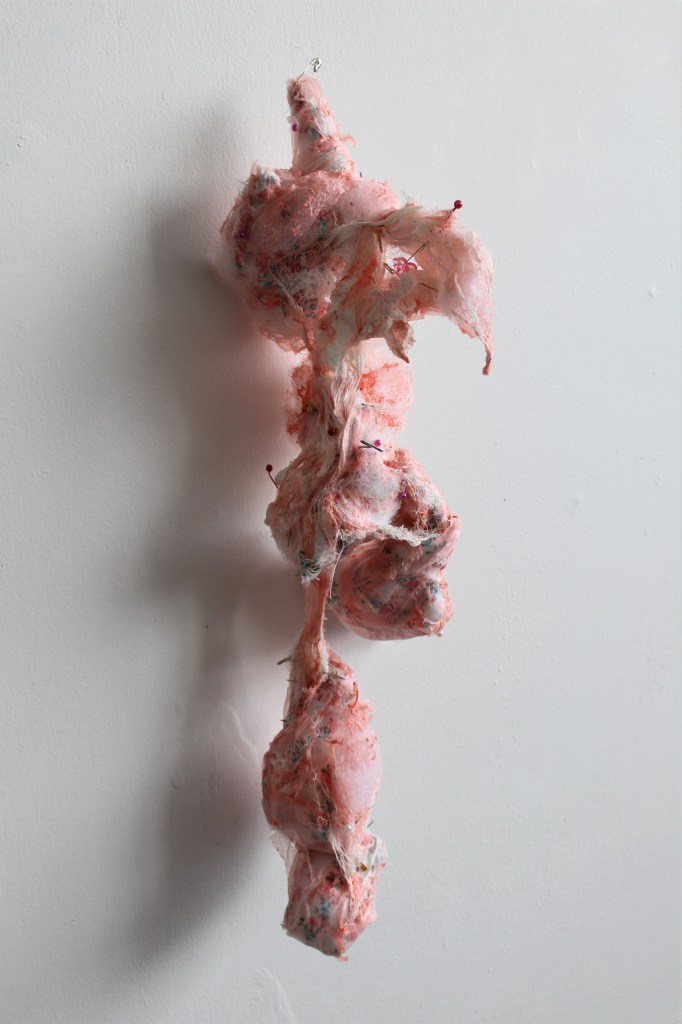
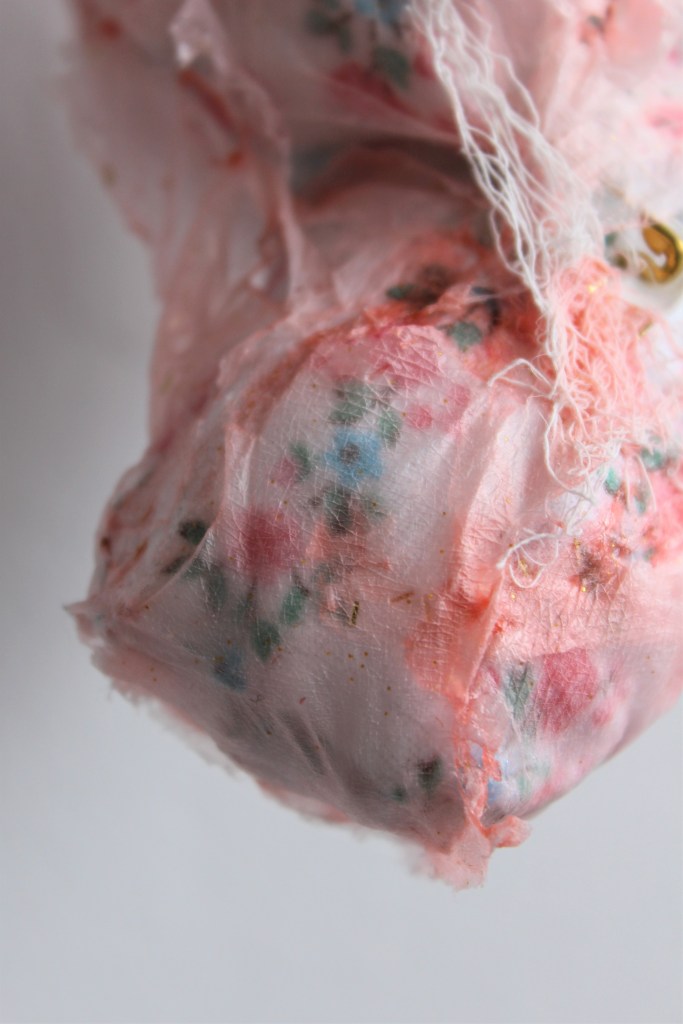
LB: There is a sense of the natural versus artificial in much of the work such as the use of cotton textiles covered in glitter glue as well as depictions of bodily systems engaged with extensions or adornments such as stick-on earrings and hairclips. Is this dichotomy important to the work?
TT: This dichotomy is relevant to the absurd conceptions of “real” vs. “fake” as they relate to our societal ideas about gender. Despite the fact that pretty much everyone in our society engages in some kind of medical interventions to their bodies, the lines around what we see as “natural” are drawn in incredibly arbitrary ways, which are usually harmful to trans people. Realistically, I would argue that no body is in any way “natural” in the sense many people seem to think of it.
LB: The plastic objects and patterned fabrics are embedded or hidden beneath a complex layered surface of materials such as latex and glitter glue which create a thick layer of peeling and afflicted “skin.” Can you explain how these works are representational of skin and how impressions of your own skin remain in the work?
TT: Part of my process involves creating “skins” for my works by allowing materials I use, such as the glitter glue used in these works, to dry in a thin layer over my own skin, which I then peel off. In this way, marks on my skin such as lines, wrinkles, and scars, are transferred into the work. I use these thin layers almost like “skin grafts.” I see the skin as a document of the body’s history, and in this way it gets written into my work as well.
LB: The textiles utilized in the work retain a sense of intimacy with the body and skin such as bedsheets and lace while many of the embedded objects evoke childhood adornment such as sparkly and colorful stick-on earrings, hairclips and bows, plastic beads, and fingernail polish. Are concepts of childhood and/or adornment important to the work?
TT: I wanted to present something about the otherness and ambiguity of trans childhood and growing up in a trans body. While these sculptures appear very strange and unfamiliar, the childhood objects I use are highly recognizable and have an immediate resonance with many, triggering strong childhood memories. These adornments are also part of my exploration of the wound of femininity forced onto the body. It’s fascinating to me how these little pieces of plastic can have such powerful associations. I was initially drawn to them because of the strong feelings they sometimes evoke for me, which I don’t fully understand myself.
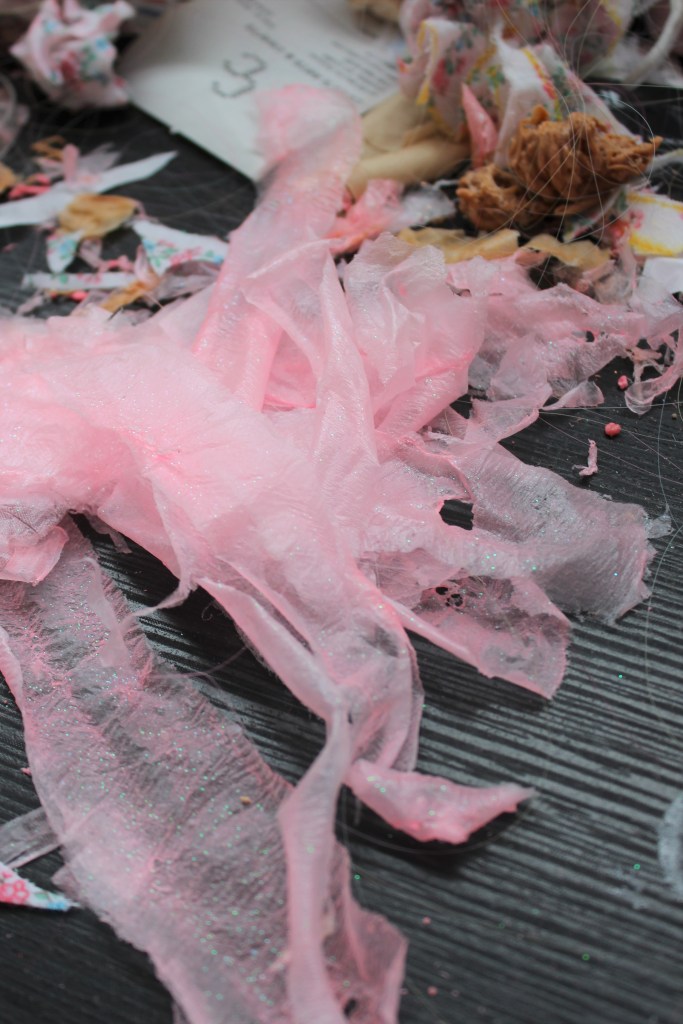
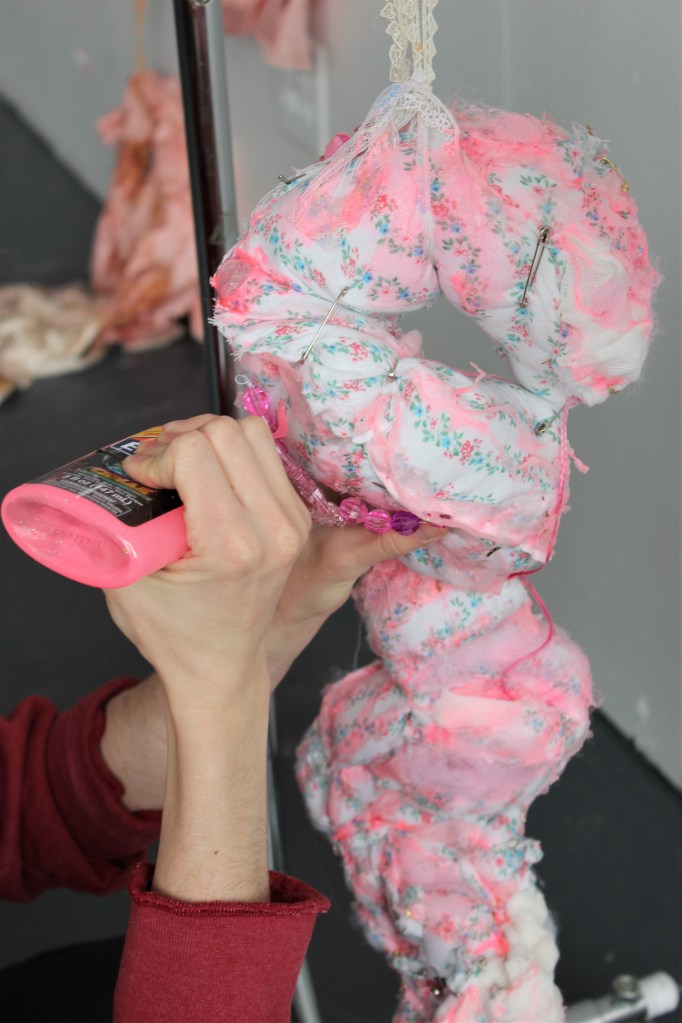
LB: The way in which these small objects are embedded within the glitter glue and latex suggests that the growth of the “skin” has overcome the presence of these obstacles. Do you view the tiny objects as embedded obstacles or as having fully infiltrated and merged with the “skin”?
TT: I feel that both would be accurate statements to describe the relationship of these objects to the sculptures’ skin. I see these “obstacles” or “impediments” as part of the body’s growth and identity.
LB: You have also consistently used medical supplies within your work such as bandages and gauze which have an inherent relationship to both textiles and the body. Visual and conceptual relationships could also be drawn from the comparison of sewing needles and pins to hypodermic needles and syringes. What function do these materials serve within the work?
TT: One important aspect of these materials is their relationship to medical transition, and my experience of it as a trans man. Syringes for example are something I use regularly to inject testosterone. I am interested in these textiles as “skins” themselves, as they protect the body as well as retain memory through stains and damage left behind.
LB: You speak frequently about the relationship between injury and healing in your work which is strongly apparent in the use of pins to pierce and puncture the work while simultaneously holding the amorphous materials together to create form. Are there other instances of this concept in the work and why is it important to you?
TT: Injury and healing is a thread that travels through all my work. In life these concepts are intertwined in many ways. I often think about instances such as surgery. In one respect, it is a violent act, in which the body is cut open with a scalpel. On the other hand, it is also an act of healing, reconstruction, or creation. The ambiguity of the work is also important here, as I intentionally leave these sculptures at a midpoint between damaged and healed. I consistently include beautiful and uncomfortable moments intertwined with one another.
Bio: Lauren Bradshaw earned her BA in Studio Art at the University of North Georgia in 2019 and her MFA in Ceramics at Clemson University in 2021. She has been included in numerous juried exhibitions across the Southeast, California, and New York. Recent solo exhibitions include Severance at the Roy C. Moore Gallery on the University of North Georgia Gainesville campus and Residue at the Slocumb Galleries on the East Tennessee State University campus in Johnson City. Other recent exhibitions include an exhibition of collaborative works with Theo Trotter entitled Ruptured Dichotomies at MAPSpace in Port Chester, NY and a three-person show with Daniel Brickman and Jeanne Ciravolo at Athens Institute for Contemporary Art in Athens, GA. Since graduating from Clemson University, she has taught art appreciation and studio arts courses at multiple colleges and universities in the Southeast and was recently accepted as a Winterthur Fellow at the University of Delaware where she will gain an MA in American Material Culture.
Bio: Theo Trotter’s work references the trans body as a palimpsest, through the marks of transformation and trauma that manifest on it. It deals with the idea of transformation as a necessary and transcendent, but simultaneously painful experience by utilizing the tension between beautiful and disgusting visual elements. This conflict between attraction and repulsion also represents injury and healing. He utilizes a variety of different media including textiles and latex. What many of his materials have in common is a pliability and fragility that mimics the flesh. He is drawn to other materials, such as lace, because of the closeness and intimacy to the skin that they evoke. Touch is an essential part of his process, and sometimes remains visible in the work as imprints in the materials.
 decoratingdissidence.com
One thought on “Studio Visit & Interview with Theo Trotter ”
Comments are closed.